



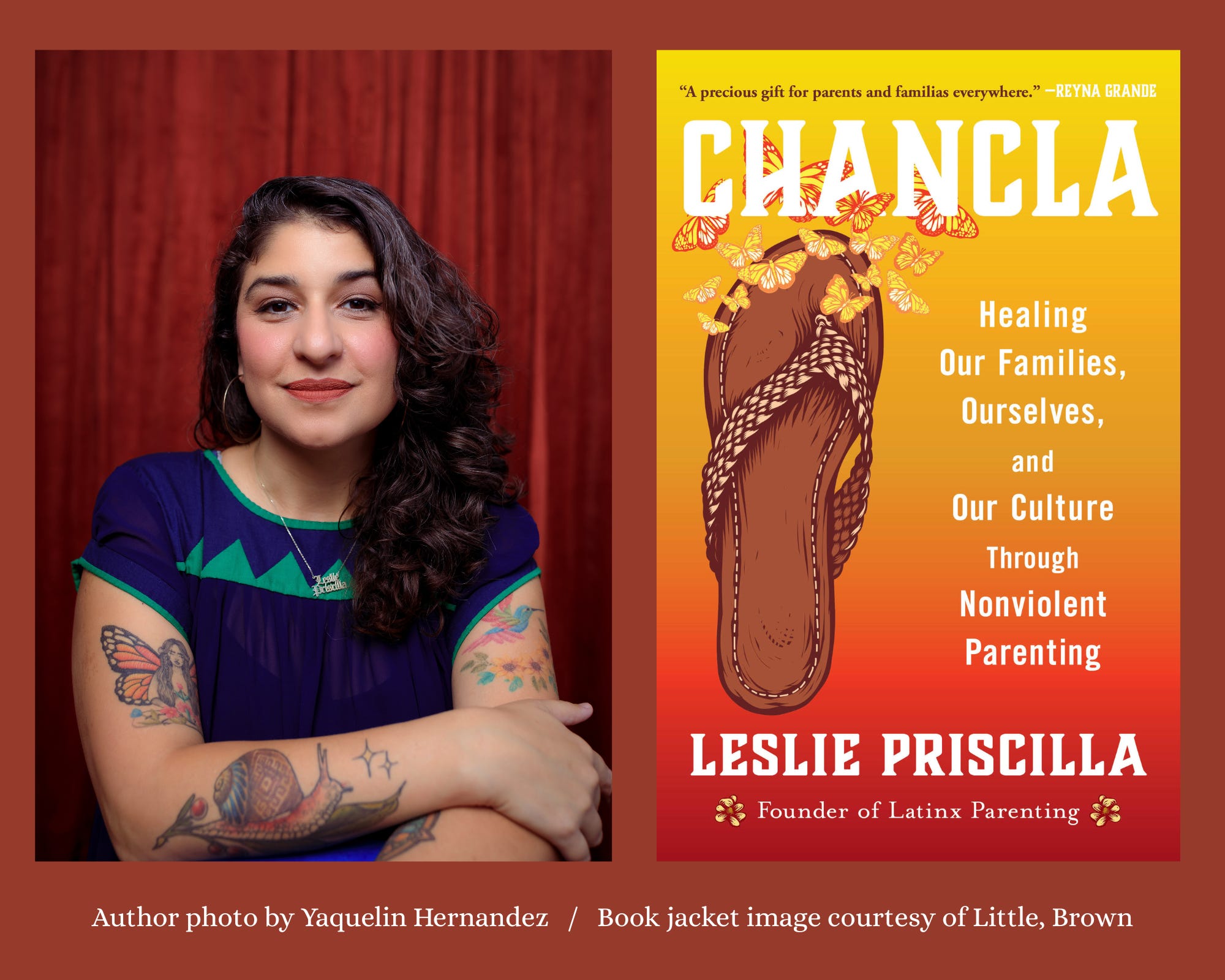
Chancla: Healing Our Families, Ourselves, and Our Culture Through Nonviolent Parenting by Leslie Priscilla is out now.
“When we model how conflict can be resolved without violence, we’re showing [our children] another way to move through a world that often defaults to force.”
–Leslie Priscilla, Chancla: Healing Our Families, Ourselves, and Our Culture Through Nonviolent Parenting, p. 3
Modern American parenting seems very straightforward on the surface. Patience, calm, consistency, boundaries, and respect are all words that get thrown around quite a bit. But when you were brought up in a very different disciplinary framework, these concepts can seem like an impossible maze to navigate.
Leslie Priscilla, founder of Latinx Parenting, is meeting that challenge head-on. Though she was raised in an environment and culture that prioritized corporal punishment and tough love over talking through emotions, her career as an adult has centered on showing new parents a different way. We at The Pom had the privilege of talking with her about the story behind her new book, and we’re excited to share that interview with you all today. Amy Colleen and Crystal-Lee Howley read Leslie’s book together, then collaborated to write these questions, which Leslie has graciously and thoughtfully answered. Amy comes from a white American evangelical background, while Crystal-Lee comes from a Mexican family, and the differences in our cultural upbringing were not as great as we might have originally imagined. The experience of reading and discussing this book opened up wonderful opportunities to talk about our own experiences parenting our children (we each have two boys!) and
Thank you for giving us and the Pom readers this opportunity to talk in depth with you, Leslie! What brought you to this career, and when did Latinx Parenting begin?
I didn’t set out to build an organization or much less a movement, actually. I initially set out to just heal myself from a traumatic childhood and adolescence and figure out a way to do things differently than the ways I had been raised for my own children. I studied Child Development in college, but even graduating with that degree, I realized that most of my graduating class with the same degree, people about to go work with children and families, still believed some kids deserved to be spanked and didn’t seem to know much about the adverse effects on the brain. This was shocking to me, given what I had been learning about trauma and attachment since becoming pregnant with my first daughter.
I had all this academic language, but when I became a mother myself, I realized that this wasn’t such a simple or easy shift to make. I had felt this fierce need to give her something different than what I’d received, but I didn’t have a blueprint for it. I was devouring gentle parenting books, but there was a discomfort that none of the authors looked like me or my family. These authors were, and still are, mostly white, mostly middle to upper class, and wrote from a place of privilege I didn’t have growing up. They wouldn’t mention that privilege in these books either. I was determined to learn more and ended up training as a parent coach under Ruth Beaglehole, a beloved teacher who taught me that nonviolent, gentle, and attachment parenting were rooted in an Indigenous worldview. Learning under her truly cracked something open in me and I started recognizing that respecting children wasn’t “white people shit,” as much as I had been told that by other Latine friends and family. This capacity for honoring children had been stolen from us.
In 2018, Latinx Parenting grew out of that uncomfortable gap I kept running into. I couldn’t find anywhere for my community to go that honored both our culture and our children’s humanity, so I set out to become that space. By then, I had been teaching parenting classes to Spanish speaking parents at local schools for five years, and something I noticed was that chancla kept coming up. But it was always coming up as a joke and was only ever met with laughter. But the stories I heard about these peoples’ childhoods weren’t funny at all. That’s when I knew this needed to be its own movement and not only a career path I had taken.
What is the most common rebuttal you receive from parents who don’t know how to begin reparenting themselves? What would you advise as a response for healing?
I write in the book that the one I hear more than any other is some version of “I turned out okay.” People will say “Well, I got hit, I got yelled at, and look at me, I’m fine.” And I truly do understand that response because I’ve felt like that’s the most peace-keeping response where I don’t need to confront anything about my upbringing. Ignorance is truly bliss, for some. This belief is a protective belief. If we admit experiences in our childhood hurt us, we have to sit with the fact that people who loved us also harmed us, and that’s one of the hardest things to hold when we haven’t known or been taught how to hold complexity.
I’m not actually attempting to debate anyone anymore about whether they turned out okay, though. What I am inviting people to do is to get curious. This is because I am curious about what “okay” actually feels like in their body, how “okay” shows up in their relationships or in the way they talk to themselves when they mess up as parents and people. So many of us are walking around with anxiety (I myself am medicated for it), or we have a short fuse with the people we love, or we develop a habit of shutting down instead of connecting. We’ve normalized these things because it’s all we’ve known and how we’ve learned to survive. When we are challenged about these things, because we love them, we can become protective of our parents by denying they did anything wrong, and beyond that, that we in fact deserved the harm we got. But I want people to understand that healing doesn’t mean we need to blame or shame our parents. Rather, it requires us to get honest about what it cost us, and grow in our compassion for them and for us, instead of resorting to blame as a default. It’s the only way we can extend it to our children, too.
You mention verbal and emotional chancletazos that can “slowly erode” parts of a child’s heart, even without intent. What choices have you made as an adult to heal those specific wounds?
Some of the deepest cuts in my life were the words said to me. Being called malcriada (poorly raised), estupida (stupid), huevona (lazy), or being told I was too much or not enough in a million other ways. Healing that has necessitated rewriting the story I tell myself. When that old voice or those stale narratives show up, I’ve had to practice catching it and asking, is this true, or is this inherited? Oftentimes, I find that it’s not my voice or narrative at all. And holding onto it benefits me even less.
Journaling and processing by writing has been huge for me. I have journals going back to the 3rd grade. I’ve always challenged myself to go back to what I’ve documented from elementary school or high school and my early 20s, and I’ve had to challenge myself to really sit with the complexities instead of rushing past the discomfort of those experiences. My therapist of nearly a decade has been instrumental, too, to offer the space to do this and doing my own Reparenting work. I literally speak to the niña I was and tell her out loud what she needed to hear back then. I’ve also had to make very deliberate choices about how I speak to my own kids, and I feel lucky that I have the privilege and tools to choose kinder words I never got to hear when I was their age, even though I do mess up sometimes. I refuse to pretend every scar has faded. Some of my scars haven’t and probably won’t fade before I die, and for the most part I’ve accepted that. But I keep learning over and over that healing isn’t linear, nor is it about erasing what happened. Rather, it’s about not letting those unconscious wounds fuel your choices, and about integrating them in our learnings about how to move throughout the world in a good and more loving way.
Do you have tips for talking with unreceptive family members about the neuroscience of child development, in a culturally respectful way?
Oh yes, I always begin by naming the importance of these relationships, because kids really do need a village, and we are not meant to do this alone. I do not have a clinical approach to this. It’s possible that when bringing this up for the first time to a relative, especially one who believes so vastly differently than we do, we are likely to hit a wall. This is because it can feel, to them, like you’re accusing them of damaging you or their children. Most people haven’t learned how not to take these things personally, after all. And that’s a scary thing for those of us who grew to place respect for our elders over many other values. Instead, I try to lead as much as possible with curiosity about their own experience first. What was it like for them growing up? What did they wish someone had done differently? Most people who raised us with fear were probably also raised with fear, yet it’s possible they’ve already broken many cycles and may not even have reflected on that. We can acknowledge that too. I really believe, and have experienced, that meeting them where they are, and being transparent about my story and experiences from my most genuine vantage point, opens a door that facts about brain science and trauma wouldn’t be able to do alone.
When I do bring in the research, I try to translate it into something that honors what the needs they were trying to meet, or what they were trying to accomplish. I would say something like, “I don’t doubt you loved us, and I know you hit us because you wanted us to survive and to respect you, and I get that. But I wonder if there are ways to build that same respect and safety without fear. Here is what I have learned…” Framing it as building on their intentions and their need for things like respect, cooperation, and mutuality instead of condemning their methods right off the bat makes a tremendous difference. And sometimes the conversation isn’t going to land for them in just one sitting, but it is worth planting the seed and letting it sit, and being patient with their learning as well. Many times they do come around on their own, as my parents have just by watching my relationship with my children, which leaves out many of the punitive strategies I was handed down.
How has your relationship with the elders in your family changed as you’ve stepped away from that disciplinary culture?
I can’t pretend that doing things differently has been easy, and it sometimes hasn’t resolved as neatly as I would like. There have been moments where I could feel that my choices were interpreted as rejection, or judgment of them and the way I was raised, even though that hasn’t been my intention. Sometimes my kids haven’t wanted the immediate physical affection my parents or my elders have asked. Their needing space and having boundaries of their own has confused some of my elders in ways that echo what you’re describing.
What’s helped me is holding these two truths at once: I get to protect my children’s right to consent and safety and I can still honor where my elders came from and what they survived in order to offer me what they did. It doesn’t mean I owe anyone unfettered access to my kids that my kids aren’t comfortable with. But I do try to keep showing up with warmth for the inner child of my elders, and I do my best to communicate in ways that keep the door open, and trusting that the relationship will hold even when it’s imperfect. Some relationships have softened over time as they’ve watched my children thrive without those old strategies. But others haven’t, and I’ve had to grieve that at my own pace.
What helped shape your journey away from the rigid expectations of Mexican Catholicism and “Catholic guilt”? What have you shared with your children about your own faith?
Faith has always been hard to define for me. It touches upon the unknowable, after all. Church and the dogma of Catholicism held real meaning in my life throughout my childhood and adolescence. I had many moments of feeling divinely held by something bigger and more powerful than myself, yet it also carried a dogma that I was once attached to that shaped harmful ideas about obedience, women’s bodies, who deserved love and redemption, and who didn’t. Marianismo, the idea that a woman’s worth is in her sacrifice and silence, was seeded into everything I was taught about being good as a young girl.
Understanding how much of what I’d absorbed as “faith” was actually a dressed-up version of colonial expectations was difficult, but I committed to learning the fuller history so that I could have a more connected connection to my spirituality. Separating the parts of it that were genuinely mine, like the sense of surrender and desahogo (undrowning) I felt kneeling in a pew, the sense of connection to something ancestral, and that gratitude for that, helped me distinguish them from the parts that were in reality just institutional control posing as devotion.
With my own kids, I’ve tried to keep the door open, sharing my learnings, but not handing them a script or expectations for dogmatic adherence. I communicate what I believe with honesty, including the parts I’m still working through. Different than what I experienced, I try to let spirituality be something they explore through their own moments experiencing presence, joy, and love rather than something used to keep them small or afraid. I want them to know that we are a part of Creation, and that we serve Creation, however they come to understand that. I want them to see the Universe and our manifestation of it as a source of love. It cannot be a manipulative threat of hell or sin hanging over their heads.
How can the interconnected support of multigenerational Latine families be both a blessing and a curse for those trying to “do it all” while also breaking cycles of trauma?
This is one of the most nuanced parts of our culture. Community, wherever we have been able to find it, has saved us in so many ways. Community is how our familias survived colonization, migration, poverty, ongoing attacks against our people, and so much more. Having a Tia who shows up with food, an abuelo who helps with childcare, or primos like mine who have become more like built-in siblings is a web of support that is something a lot of individualistic cultures are seriously and desperately missing.
Yet that same web can become tangled up in expectation or strings attached around “how we do things.” It can feel heartbreaking when stepping outside inherited norms is treated by our loved ones as betrayal. Our multigenerational closeness can feel less like a gift when it becomes much harder to set a boundary, because it feels like we’re often not only disappointing a person but an entire system that we’re supposed to cherish or otherwise be seen as ungrateful and disrespectful. I think the work is learning to take the nourishing and nurturing parts of interdependence, showing up for each other, helping each other carry the load, staying close when we can, all the while releasing the parts of this intracultural journey that demand silence or conformity as the price we have to pay in order to belong to our families and be accepted and loved unconditionally.
What advice would you offer a parent trying to embrace nonviolent connection when their partner isn’t on the same page?
This comes up constantly! I want to say first to this parent that you are not failing because your co-parent isn’t there yet. We can only be responsible for our own healing and our own behavior with our children. That is actually enormous. Despite what we have been told, kids very much can hold complexity. They can understand that mom responds this way and dad responds that way, especially if you’re not badmouthing your partner in front of them and you’re modeling consistency in your own relationship with them.
That said, I do think it’s worth having direct, non-shaming conversations with your partner outside of conflict moments, and not in the heat of a meltdown. Kids need to have examples for what healthy disagreements can look like. But it may be worth finding the right moment to share what you’re learning and invite them in rather than lecturing them. Sometimes our Inner Niñe can get triggered in these conversations when people feel they are being accused of doing things “wrong”, and sometimes a partner needs to see the results before they can begin to believe in the process. It’s important to note, though, that if there’s real harm happening, or if discipline becomes violence against kids, that’s a different conversation. When that happens, it’s now about safety, not just differing opinions, and I’d encourage seeking outside support from a licensed professional for that.
How do you handle the apology to a child, the “rupture and repair,” when you want to own your part in an emotional outburst without letting them off the hook for what they did?
This is something I am very transparent about in the book because even with all of my cognitive knowing about these things, being able to practice it without fail is impossible and I very much still get it wrong sometimes. In my book I wrote about an instance in which I called my teenage daughter Hallie a “sneaky brat” after she lied to get around an age restriction on an app. As much as I took it back, the damage had been done. Repairing ruptures is more about each of us owning our own piece rather than deciding who was more wrong.
In practical terms, that means I regulate myself first by the tools I’ve learned that have become my “oxygen mask”. I don’t apologize while I’m still activated, because it usually comes out sounding more like a justification, and the truth is that if I’m still activated, I probably still don’t feel sorry. Once I can reclaim my calm, I will be able to go to my child and take accountability for exactly what I did and apologize, without a “but.” Something like, “I was feeling stressed, and I called you a name, and that hurt you. I’m sorry. You did not deserve that.” That’s it. We don’t need to continue blaming them for making me react that way.
Once we’ve reconnected, there can be space made to talk about their part too. My teen and I still had the conversation about her lying, and why honesty matters for her safety online. It was a teaching and learning moment for both of us. But that conversation was so much more productive once the hurt was soothed and the emotional rupture was repaired. Kids can’t really hear accountability, or even learn what it should actually look like, if they’re still bracing for more shame. Repair first and discuss the lesson, and again, never make the lesson conditional on them forgiving you.
What other books would you recommend for parents trying to reframe their approach to discipline and connection?
A few that have shaped me deeply and that I recommend often:
The Pain We Carry by Natalie Y. Gutierrez
Break the Cycle by Mariel Buque
Decolonizing Therapy by Dr. Jennifer Mullan
My Grandmother’s Hands by Resmaa Menakem
What it Takes to Heal by Prentis Hemphill
Recovering Our Sacredness by Maestro Jerry Tello
Braiding Sweetgrass by Robin Wall Kimerer
Raising Free People by Akilah Richards
Born for Love by Bruce Perry
Parenting from the Inside Out by Dr. Dan Siegel
Sacred Instructions by Sherri Mitchell
Decolonizing Non-Violent Communication by Meenadchi
Nonviolent Communication by Marshall Rosenberg
I’d also point people to Where Silence Ends by my friend Angela Rioz and her mother Mary Ruiz for anyone doing deeper work around generational abuse. None of these were written specifically for our comunidad, which is part of why I wrote Chancla, but each one gave me language and tools I didn’t have before, and I still return to them. There are so many others. People can find my full list of recommendations here.
We (Amy and Crystal-Lee) appreciate Leslie’s time and effort in answering these questions for us! Chancla is available via Bookshop1, as well as most other online book retailers.
This is a lengthy and densely informative book, and the topics involved may be triggering for some readers; we recommend pacing yourself as you work through it. We give Chancla four stars.
Thank you to Little, Brown Spark for advance review copies. We were under no obligation to present a positive review.
Follow The Pomegranate on Facebook, Instagram and Bluesky for more, and join our subscriber chat here on Substack. If you enjoyed this post, please forward it to a friend! Interested in writing for us? Check out our submission guidelines.
As a Bookshop affiliate, we are eligible to receive a small commission if you choose to purchase using this link, at no additional cost to you.
