

I'm Trying to Raise a Child, Not an Athlete
But we're in too deep.


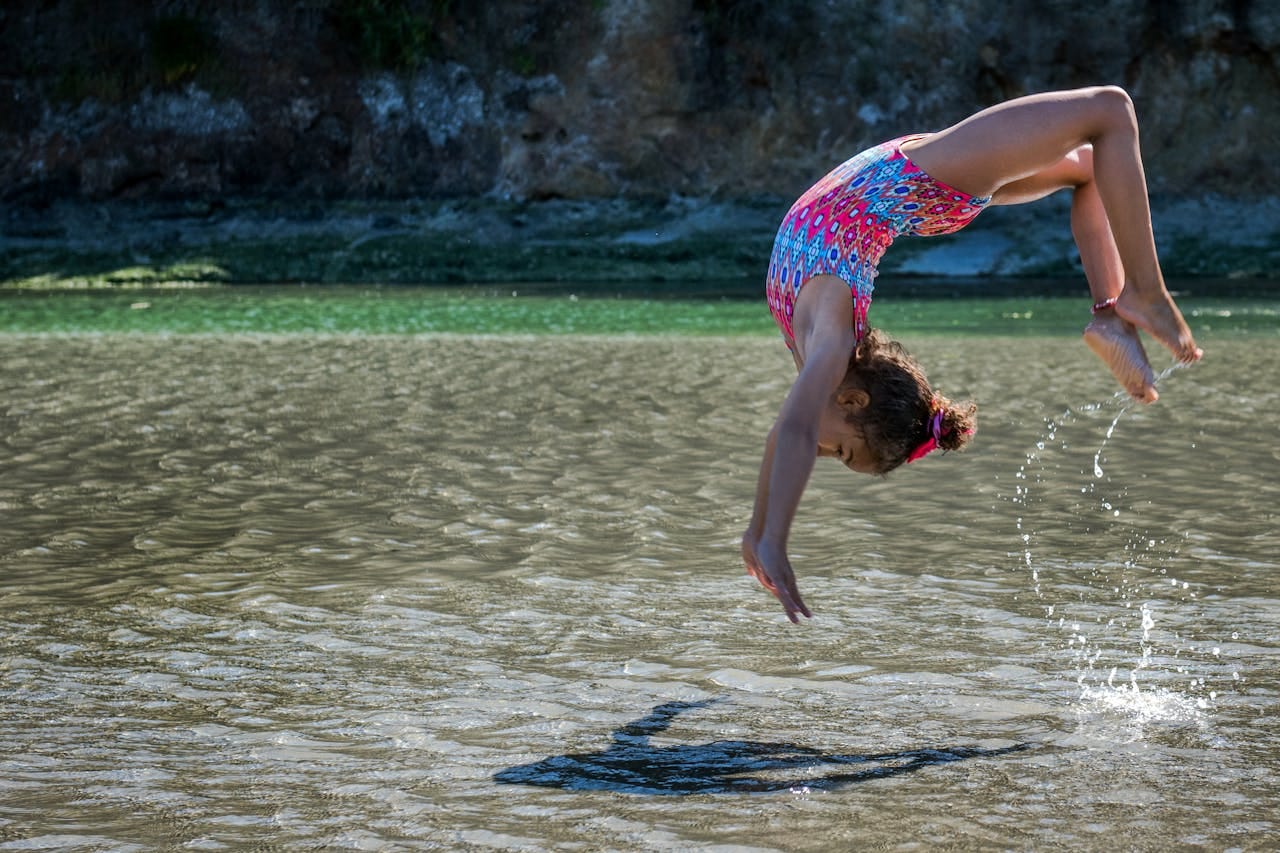
One of the best lessons I learned about parenting came from a puppy training class I took several years before I ever had children: “a tired puppy is a well-behaved puppy.” This lesson has become a tenet for me as I’ve raised three high-energy children. My kids are at their best when they’ve gotten plenty of exercise.
They’ve all been in sports since they were toddlers, back when sports meant “$40 per session to stand around a gym, hoping they’ll participate in Head, Shoulders, Knees, and Toes.” My husband owns a swim club where he runs lessons and a kids’ team, so we had our kids swimming laps by preschool. We put them in a track and field program in the summer. I gently nudged them all toward soccer, because even though I never played it and didn’t know much about the game myself, it’s clearly the runningest of all the team sports.
All this to say, we are a sports family. I love sports! I loved playing them as a kid, I love watching them now, and I’m glad my kids are active and making friends with other active kids. It’s good for them.
Then last year, my daughter found her passion: cartwheels. She wanted to do a cartwheel. Passionately. I signed her up for a beginner’s gymnastics class, and before long, she could do a pretty good cartwheel. Mission accomplished!
But she loved all of it, not just the cartwheels. The class had also introduced her to the beam, the uneven bars, the vault, and a group of other older girls who could do handsprings and backflips like they were experiencing life on a different plane of gravity than the rest of us. She wanted in.
So I signed her up for the gymnastics team. And now we are in deep.
Gymnastics is a notoriously serious sport. We’ve all watched the summer Olympics. I’m one of those people who watches the Games and thinks, “I could play water polo,” or “Speed skating looks easy,” but when I see the gymnasts, I am humbled. It’s obvious to even the most amateur viewer that these girls have devoted their lives to training. I don’t hold a single delusion about my lack of gymnastics ability.
Because of this, I was nervous when I signed my daughter up for the team she chose. I knew she was serious about the sport when she chose a gym based on the coaching she received at her tryout, instead of going with the team that some of her school friends were on. My husband and I liked the coaches too, but I became nervous as I read through the handbook.
The handbook stressed that if my daughter were to join the team, gymnastics would take full priority over other sports. Practices were twice a week, from 4pm-8pm. Gymnasts were allowed to miss only two practices over the year. More than two and there might be a discussion about their commitment to the team. If a gymnast missed a practice the week before a meet, they would not be allowed to compete (and, by the way, parents will write one big non-refundable check for all meets at the beginning of the year).
These rules immediately made me bristle. My daughter was SEVEN. What if she wanted to try other sports? She still wanted to swim, and she was having fun with soccer. She’d never even tried baseball or lacrosse. I didn’t know if I was ready to let her commit so hard to one sport.
The other thing that bothered me was wondering, what is this all for? As the owner of a kids’ sports team, I know firsthand that many parents fully expect their kid to go pro or make it to the Olympics. I don’t. I’m aware of the fact that no matter how hard my daughter trains, for most athletes the ceiling is probably college—which is great! To me, the value in playing a sport is playing the sport, and if a college scholarship is tacked on as a bonus, I’ll take it. But was that really a big enough prize to justify revolving her finite years of childhood around a practice schedule?
And then the other other thing (uh oh, I’m spiraling) is that I don’t know what this will do for her sense of herself and her body image. Currently, it seems great: she is finding out what her body is capable of and how strong she is, and entering life on that different plane of gravity she saw the other girls moving in has given her a new freedom. Still, I worry that a serious and competitive sport might become too much pressure as she gets older, and worse, that the size and shape of her body will become something she starts thinking about too much.
The youth sports landscape is such a different terrain than it was when I was a kid. When I was growing up, baseball was my favorite sport. It was a spring sport, so I played it for about three months between April and June. Then for the rest of the year, I played whatever other sport piqued my interest at that given moment. I dabbled in basketball, track, a couple years of figure skating, and there was time for other activities too. I found a love for theater in a two week long summer theater camp and joined writing groups that were a foundation for my entire adult life. There was time for all of it. Now, there’s a push for kids to specialize in their sport. It’s common for teams to make kids sign an actual contract stating that playing this sport will take first priority.
The specialization gives me the same feeling I get when I see elementary schoolers with cell phones—that the parents of these kids are moving the bar for the rest of us. Some of them do it, and then the more impressionable parents give in and do it, since other people are, and then the stronger-willed parents still refuse to do it, but it puts their child at a disadvantage. A select few parents decide that their kid is going to be an Olympian, others follow their lead, and then everyone else feels like they can’t keep up unless they do the same.
I love that my daughter has found her calling, because I really believe she is a gymnast at heart. I don’t know what else to do but to let her make the call when it comes to her commitment to the sport. So I’ve set two rules for myself and my husband as the parents of an athlete:
First, we keep a close eye on the sport and set boundaries. Recently, her coach sent us a message saying that our daughter isn’t quite ready for the first meet of the year, and she might need a private lesson to catch up if she wants to score well. We immediately reached out for clarification. Was the concern that her current abilities would hold the team back, or did the coach think that we cared about how our eight-year-old scored in her very first gymnastics meet? Because we know many parents do. Our daughter had come home thrilled the previous week because she finally landed a back handspring. That was what we cared about. Communicating with the coach put us all on the same page—our only goal was for our daughter to enjoy working at something she loves— and the knot that had tied in my stomach quickly loosened.
Second, when she’s done, she’s done. If at any point our daughter tells us she wants to quit, we let her quit. There won’t be any coaxing about the time and effort she’s already put into the sport, or the loads of money we’ve spent on it. The moment she decides it’s too much, or that she has found a new calling, she can stop and move on to something else.
Is this good enough? I have no idea, and I probably won’t know if I’ve handled this right until my daughter is an adult and approaches me to be reimbursed for a therapy bill. I’ll continue monitoring the situation and helping her set boundaries, and we’ll see where it goes. For the time being, it’s at least nice to have a powerful little eight-year-old in the house who can open stubborn jars for me.
Another thing to think about - college coaches say they prefer multi-sport athletes. Kids prefer to play multiple sports. So why all this “mandatory year round commitment” “required to be your first priority” stuff? In a large part this is about money. Private equity is gobbling up club sports teams and the profit motive overshadows all.