

Bluey Is Not a Perfect Show (and that's okay)
The cartoon dogs may have stolen our hearts, but we’re not taking (all our) parenting lessons from them.


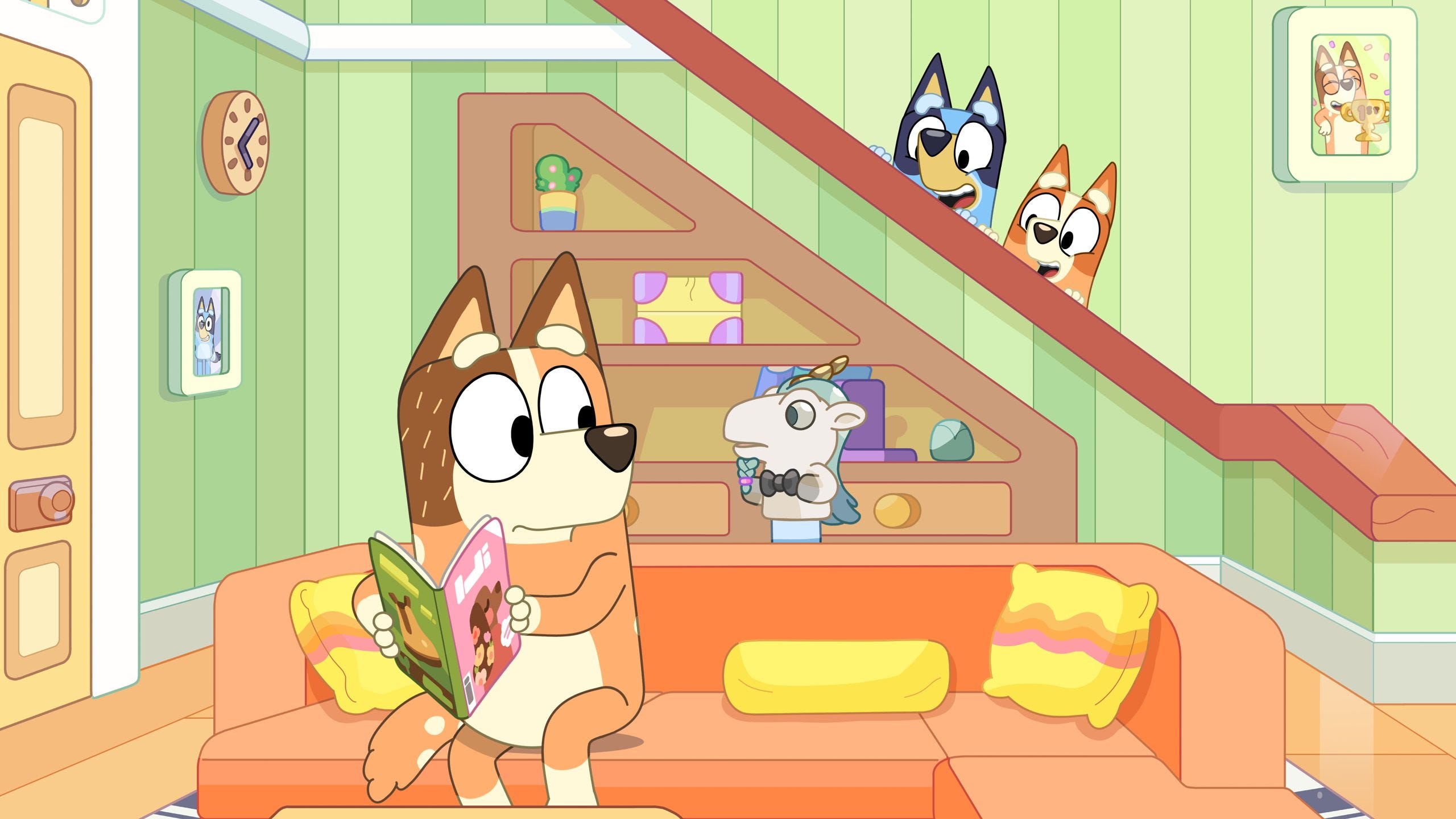
Like many mothers of young children with no free time but a surplus of free thoughts, I (Hillary) have a lot of thoughts about Bluey. Perhaps too many, honestly; talk with me for about five minutes and you’ll probably hear me praise the show enthusiastically but talk to me for fifteen minutes and you’ll hear me criticize it over four or five different reasons and be ready to hash it out right then and there in the grocery aisle.
I love being friends with Amy because she’s right there with me (on both motherhood and Bluey). It’s not even her first time delving into it online! Once upon a time, not long before Elon Musk’s takeover of Twitter turned it into a complete hellhole, Amy wrote a tweet that garnered a fascinating amount of anger from an unexpected group of people: fans of the Australian children’s cartoon on which this article centers.

The indignant comments came thick and fast.
The Bluey Haters are kind of easy to ignore. They mostly hang out in Facebook mom groups, clucking disapproval over any children’s show that doesn’t whap every viewer over the head with an unambiguous moral conclusion, or that has primary colors, or that appears on any screen whatsoever. These people don’t want to be satisfied and it’s a waste of time to argue with them.
But the Adult Bluey Fans are a more nebulous bunch. Unlike Disney Adults or Bronies, these folks aren’t childless adults finding comfort and nostalgia (or a weird kink) in a program explicitly designed for children; more often than not, these are parents with kids in the right age group for Bluey who have co-opted Bluey for themselves. They won’t brook any disagreement with fundamentals of the show and sometimes seem parasocially connected to the cartoon dogs–while also arguing that since they are cartoon dogs, they cannot be reasonably criticized.
Spend any time in online Bluey spaces, and one thing you’ll notice is that the fandom itself isn’t actually in agreement over who the intended audience even is. I say that with a hint of hyperbole since the show is clearly marketed towards young children, but for every episode imparting a lesson to children there seems to be one targeted towards imparting a similar lesson towards the adults in their lives as well (see: “Unicorse,” episode 3.8). And when it comes down to it, all of our gripes are directed at the adults in the show and not at the children. We don’t expect perfection from growing beings, discovering the world through play. Muffin might be annoying and setting a less-than-ideal example for our kids, but she’s a developmentally-appropriate example of a 3yo toddler too, and we’re not going to hold her to unrealistic standards. We don’t even expect perfection from the adults charged with their care, but that doesn’t mean we approve of the decisions that get made either. With Bluey, the children are simultaneously asked to make decisions that have actual impacts on other people (“The Sleepover,” 1.39) while also being shielded from the natural consequences of their own actions (“Ice Cream,” 2.47, “The Pool,” 1.22).
And look, I feel the need to stop the retort that I can feel coming deep in my bones, borne from the mouth of Bandit Heeler himself in episode 2.28 (“Movies”): “Look, it’s just monkeys singing songs, mate. Don’t think too hard about it.” No. Bandit is wrong (not for the first time), and repeating that line is a lazy, thought-terminating cliche. We do, in fact, want to read stuff into it. It is a meticulously-crafted show made with specificity, care, and attention, and as parents who care specifically about what their children pay attention to, we are here for in-depth Bluey conversation.
I say “we,” because Amy and I have talked so, so much about this show. This is a fairly regular topic of correspondence for us, in fact. We’re reproducing some of our unified impressions here because otherwise the thoughts will have nowhere to go except out through our ears in an explosion of cartoonish rainbow fuzz it is one of the most-streamed shows in the world, and for good reason. Our kids are just the right age1 to be enraptured by Bluey and Bingo, and we’ve enjoyed watching—and dissecting—the show right along with them. We both firmly believe that good storytelling can withstand close reading, and that the lasting meaning of Bluey deserves to be seen through an honest lens.
So let’s get our beef out of the way right now. We have some notes. Our primary issues with the show can be summed up briefly as such:
Several of the boundary-setting choices the parents make seem weak and easily downtrodden by the children, who are rarely given a firm “no.”
Bluey is often sassy to her parents in ways that are funny to begin with (and maybe a little too quotable) but are very easily imitated by small children who enjoy any excuse to talk back to adults.
The Heelers never wear clothes but we see them doing laundry all the time. What gives. (This isn’t really an issue with the show, Amy just likes to point it out to anyone who will listen, which is… not many people.)
Most glaringly, the show takes pretend play (a wonderful thing in and of itself) to a point that feels obnoxious at times.
Let’s look at some examples. “Rug Island” (2.10) is, in Amy’s opinion, perhaps the most egregious. Though on the surface it’s a sweet example of totally immersive imaginative play, the game’s all-encompassing nature reinforces children’s natural tendency toward self-absorption and disregard for others’ feelings. Like Muffin’s behavior, this is developmentally normal, but it doesn’t mean that the parents should be encouraging Bluey and Bingo to keep Lucky and Pat’s ball. Bandit even tries to get the girls to return it and then is convinced to stay in character and chase his neighbor away, keeping Lucky’s toy and sitting passively by while his children slobber all over it. Biscuits.
In “Chest” (3.11), Hillary argues that Chilli’s insistence on foregoing the actual rules of the game and setting up head knowledge versus heart emotions is a poor lesson. A seven-year-old absolutely is capable of learning the basic rules of chess, but the larger message is deficient: heads and hearts do not need to be in conflict with one another, and it is often by shaping a child’s mind through learning that the heart is guided too. One does not build upon the other like stairs, but both are vital components from the beginning.
Amy actually doesn’t like to let her kids watch “Faceytalk” (3.24) or “Tina” (3.21) at all. Listen, Muffin is completely out of control in “Faceytalk,” and even if her behavior is not being portrayed as acceptable, (we appreciate that!) it—and her own parents’ arguments about how to discipline—is still being dramatized for children who aren’t necessarily old enough to grasp the nuances of why a character stealing a phone and throwing it in a pool is actually not a fun game to play. At one point, Hillary’s now-6-year-old started stomping her foot and yelling “Cowboy hat!” when she didn’t get her way. HARD PASS ON THAT ONE, CHICKADEE! And Tina? Ugh, don’t even get me started on Tina. At a certain age, “obey your parents because it’s our job to take care of you and keep you safe” is all that’s required; the role-playing of I’m Bigger And Can Cartoonishly Beat You Up is sending a deeply unnecessary message, even if it is mildly explained away at the end (so mildly in fact that Bluey even says she didn’t remember the point of the message in “Show and Tell,” 3.42).
Hillary has a bone to pick with Bandit’s spousal support in “Sheepdog” (3.12). Though yes, he does take on the job of keeping the girls quiet so Chilli can have 20 minutes where no one comes near her (and every mother says “yes, amen”), he gets far too into the game and doesn’t actually prevent Bluey from going and bothering her mom, thereby failing his one singular task.
Amy is annoyed by “Trampoline” (1.33) and the way that Bandit is constantly being distracted from work (this happens in “Yoga Ball”, 1.16, too!). Yes, flowers may bloom again but a person never has a chance to be young again, as we learned in “Takeaway” (1.14). But Bandit isn’t la-de-da-ing about looking at blooming flowers rather than playing with his kids; he’s trying to leave for work! Parents still have to pay the bills despite the siren call of imagination, and kids need to learn that fact.
“Omelette” (3.5) is an episode that has always bugged Hillary, not just because of the fact that Bingo’s “help” in the kitchen is incredibly wasteful, but because Bandit is being treated really badly on his birthday. It’s great that Bingo gets to feel included, but at the expense of her father getting any breakfast? Sometimes kids just need to learn that a task will be accessible when they’re bigger. (The Heelers actually kind of just suck at caring for the birthday person in general, as evidenced by Bingo being consistently ignored in “Handstand” [2.45].)
We are not-so-hotly divided over “Ice Cream” (2.47); Hillary leans toward the kind-but-strict response of “I’m sorry, but that’s what happens when you don’t eat your ice cream! Next time work out the licking thing or just don’t trade!” while Amy agrees with this theory but knows in her heart of hearts that she would be a pushover like Bandit and hand over her own ice cream. (Although it’s worth pointing out that none of this would have been an issue if Bandit had just stopped the licking dance right at the outset. Nip it in the bud, as Barney Fife would say.)
We could go on. (And we will, in the comments. Join us!)
One thing we definitely understand is the issue of narrative progress: if Bandit and Chilli always made all the choices that we consider to be developmentally and relationally healthy (a feat we ourselves have yet to achieve) the show would be extremely boring. All stories need conflict and poor decisions to fuel drama, and those can come from all angles—including the parents! After Hillary’s beloathed “it’s just monkeys singing songs, mate,” this is probably the second most common retort to pointing out any problems that we personally have and it’s a far more compelling response. That said, when we tout the show as a “masterclass in parenting” or call Bandit a “transcendent” dad making real fathers feel bad about themselves, we may perhaps have lost the plot just a tiny bit.
The Guardian piece linked above (the one that compares Bandit to Barack Obama) notes how Bluey reversed the TV trend of the hopeless, bumbling father figure found in Peppa Pig and The Simpsons. This is a positive development for sure, but when the bar was set so insanely low for so long, any involved dad is going to look like a candidate for canonization. It’s okay to expect better and to want Bandit to use soap when washing pee off his foot.
We probably seem as though we are coming down really hard on Bluey, especially to those of you who may consider yourselves in the diehard fan camp, and we promise that’s not the intention. There is so much to love about this show. (The mere fact that we could talk about its ins and outs for hours puts it light-years ahead of any other children’s television offering! We can’t imagine feeling this strongly about, say, Blaze and the Monster Machines.) The emotional connection the Heelers share is beautiful to watch; the music is splendid; the animation isn’t frenetic like so many other cartoons; Chattermax is the evil demon antagonist of our nightmares. We’ve never felt more seen by an episode than “Sticky Gecko” (2.12), to the point that it horseshoes around to being almost hard to watch at times. “Sleepytime” (2.27) is legitimately a perfect seven minutes of television, and not only “for a kids’ show.” We’ve been inspired to make chores fun by “Housework” (3.13), and taken solace from “have a little cry, dust myself off, pick myself up, and keep going” a la “The Show.” People come into our lives and then leave again like Jean-Luc; friendships evolve and change as with Mia and Captain; sometimes we have to tolerate kids (and adults!) who are space invaders like Winton. It’s part of being human—no, wait.
Some of the things you might think we’d have a problem with, we actually don’t! For instance, we both love the controversial extended-length episode “The Sign” from season 3. (Amy wrote about “The Sign” in depth here.)
Bluey has infiltrated so much of how we talk and play with our kids: for the better, to be clear. Before we leave the house, we insist on a tactical wee; no one is a bad kid, we sometimes just behave bad; and we now refer to “Lucky’s dad’s rules” without exception when discussing birthday party games. “I’ll always be here for you, no matter what,” we tell our sleep-fighting kids (“Baby Race”). But yes, we do watch TV after you go to bed (“Unicorse”).
Speaking of games, there are arguments to be made against the fact that the parents play so interactively with the children on such a regular basis. Some have pointed out that the episodes are only about seven minutes long, and therefore we shouldn’t extrapolate more than seven minutes of intensive pretend play. But this argument falls apart when you consider the passage of time in most storylines; the seven-minute theory really only applies to episodes like “Takeaway” (1.14), where Bandit and the girls wait for a Chinese food order to be ready, “Blue Mountains” (1.21) which comprises a single pretend game during a picnic, and “Driving” (3.20) where Chilli and Bluey play a game during a 5-minute timer.
To be entirely fair, Joe Brumm, the show creator and writer of nearly every episode, has gone on the record saying that the deeply involved roleplay in which Bandit frequently immerses himself is a choice made to enhance the humor of the show, with the full knowledge that most child development experts recommend parents take a back seat for “pretend games.”
And though we have cried over “Baby Race” (2.50) and “Cricket” (3.47), the humor of the show is what balances the warm and sentimental moments and sticks with us in our daily conversation. (“Out of the way, power bill!”) Bluey isn’t, at its heart, a parenting lesson. Nor is it a morality tale to inspire children to emulate. (Children don’t really like that kind of thing anyway, it’s worth noting.) Ultimately, it is storytelling, and needs to be viewed and absorbed with the nuance that went into creating it. Bandit and Chilli aren’t perfect; Bluey and Bingo aren’t perfect. Joe and Dan Brumm and their co-creators aren’t perfect! The fact that an episode ends should not mean that nirvana has been achieved. Rather, we can learn about ourselves and look inward by enjoying the antics of the Heeler family, while feeling a kinship with the exhaustion and pride that Bandit and Chilli radiate when watching their children play together.
It isn’t perfect, and we don’t really want it to be. We want to see ourselves in the messy, sticky, crumb-ridden-back-of-the-car. We aren’t perfect, and we shouldn’t expect the Heelers to be, either.
Perfect, as Chilli tells Bluey in the episode of that title in season 3, is tough. Being a parent is tough. So is drawing. So is drawing life lessons from a seven-minute cartoon about four Australian dogs. But there’s something you need to know:
You’re doing great.
Anyway. Sleepytime rules and Rug Island drools. You know we’re right.
Hillary Moyer is a mom of two, a history aficionado, a connoisseur of good lattes and a close reader of every show she watches.
Amy Colleen is the senior editor of The Pomegranate.
Follow The Pomegranate on Facebook, Instagram and Bluesky for more, and join our subscriber chat here on Substack. If you enjoyed this post, please forward it to a friend! Interested in writing for us? Check out our submission guidelines.
Hillary has a 6yo girl and 4yo boy; Amy has a 5yo boy and 3yo boy. In the interest of fairness to our subject we need to note that Hillary’s kids are best compared to Bingo and Socks, and Amy’s are Muffin and Bluey. This, without a doubt, colors our perceptions of the storylines.
 | A guest post by |
My kids are 12 and 5, but are still big fans of Bluey. Loved these thoughts and have had many of them myself. Though I will admit feeling a little let down when the Heelers didn't actually move in The Sign. Totally get it from a storytelling perspective, but were going through a pretty big move at the time and I had to explain to my kids that no, we couldn't just change our mind and get our house back like Bluey. 😅