



The Pomegranate is thrilled to welcome Taylor Schumann as a Contributing Writer.
Today I saw an Instagram Reel from a local real estate agent advertising a home for sale. The main selling point? “A Backyard Built for a 90s Childhood.”
Spend any amount of time on social media these days and you’ll probably be hit with no less than 37 posts about “being a 90s mom” or “giving your child a 90s childhood.” It has quickly become a popular content strategy for moms who publicly say they aim to give their kids a simpler, slower, less screen-y childhood (like the one they had) and now apparently one for realtors as well.
One notable theme I see is this idea that motherhood was easier in the 90s. I can see where they are coming from. I’ve thought this many times myself. Moms in the 90s didn’t have to worry about iPads, internet gaming, or pervs trying to befriend their teenagers on snapchat.
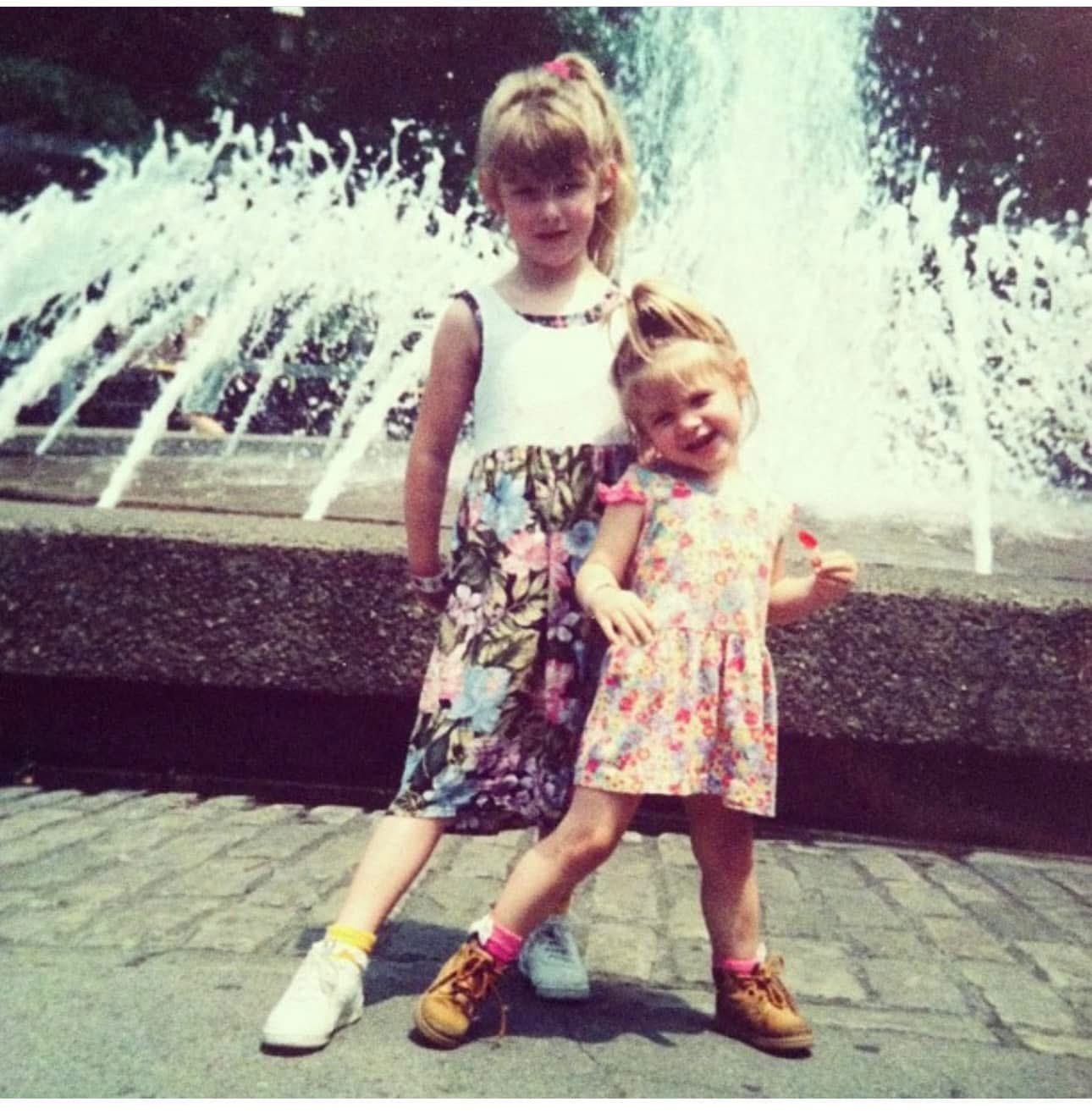
I was born in 1990 and feel like I grew up in the sweet spot of having a 90s childhood and an early 2000s adolescence. I had the sleepovers, the nights picking out movies at Blockbuster, and I played outside for hours with my friends in our neighborhood without ever checking in with my parents. I didn’t have a sip of water during the summers that didn’t come from a sort of rusty garden hose in someone’s backyard. My bike tires wore out faster than my dad could replace them. My sister and I watched whatever was on TV, racing to grab snacks during commercial breaks and get back in time for the show. It was not perfect, except it was a little perfect.
When I was a kid and my mom needed a break, she could sit us down in front of the TV and put a VHS tape in the VCR. For a run time of 93 minutes, she knew exactly what we were watching. We couldn’t switch it to a movie she had never heard of on another streaming platform without her knowing. She didn’t have to keep coming back to make sure we were watching what we were supposed to. Now, when I want to let my 7-year-old watch a show so I can fold some laundry or get dinner started, I would only be a responsible parent if I checked back every so often between folding t-shirts to make sure he hadn’t navigated over to a show I didn’t know about. And that’s in addition to the 2-3 hours researching and setting up parental controls before we even turned the TV on. Being able to pop in a VHS tape and forget about it? Dare I say, the 90s beckon me.
When I became a mom in 2018, I did what every mom-to-be does: I went to the internet to learn what I should buy and what I should do and what is the best car-seat-stroller-combo in my budget? I found answers to questions I never knew to ask. This led to years of taking any question I had to the internet, looking for another mom who was smarter and wiser than me and would help me know what to do to prevent the inevitable traumatization of my children due to giving them red dye 40, or whatever. This is when I realized I could know what other moms were doing all the time, and what their houses looked like, and see the perfectly nutritious meals they were feeding their kids. This is also when I discovered we aren’t supposed to be saying “Good job!” to our kids anymore. It’s going to destroy their intrinsic motivation to complete tasks, or something. Anyway, my mom didn’t have any of that in the 90s.
My mom couldn’t scroll TikTok for 20 minutes and within that time frame discover 16 new fatal diseases or accidents from which her children could die, leading to uncontrollable anxiety about every potential danger, even the ones that she didn’t know existed until that second. She could let us play outside for hours alone without worrying if Debbi down the street was going to call the police and report her for negligence.
But she also didn’t have grocery pickup or the ability to check my location on a cell phone to make sure I was safe. She couldn’t use the GPS on her phone to get us to a friend’s house and if we took a wrong turn, well, guess we’re spending the night there. My mom couldn’t pop in AirPods and inconspicuously listen to an audiobook while doing menial tasks or to tune out another episode of Paw Patrol. No one had the ability to set up a meal train for her and quickly send the link to her family and friends when she was freshly postpartum. And when she was up alone in the middle of the night with one of us screaming children, she couldn’t send a text reaching out for support to a friend who she knew was probably also up in the middle of the night. She couldn’t do a quick internet search for a picky-eater-friendly recipe when she didn’t know what to make for dinner, or google dosage for a medicine when she lost the packaging.
If I had to say whether or not I think motherhood in the 90s was easier, which I guess I do, since I am the one writing this essay, I would probably say yes. The thing is, however, I am extremely hesitant to use any variation of the word “easy” to describe motherhood at any point in the history of time. Motherhood is an experience that transcends time and demographics, and yet those things play a substantial role in the way you experience it. If I would have had it easier, another mom would’ve had it harder. I wonder, too, if we as millennials moms are the first to question if our moms had it easier. I’m not sure my mom ever thought her mom, who was raising babies in the late 1940s and 1950s, had it easier than she did.
The 90s, despite how we may look back on them, were not easy and simple for everyone. In the early 90s, the AIDS Pandemic was still ravaging communities. In 1992, racial relations came to a violent head in LA following the acquittal of police officers in the beating of Rodney King. The Gulf War was still going on, the World Trade Center was bombed, and 168 people were killed in the bombing of the Alfred P. Murrah Federal Building in 1996. Then we looked on as the news covered the scandal involving Monica Lewinsky and President Bill Clinton, and his subsequent impeachment. We finished out the decade by thinking the world was going to end on December 31, 1999 when the clock struck midnight.
I remember seeing headlines for many of these events on my parents’ TV screen and on the front page of the newspaper. But I was a white kid living in a little yellow house in the suburbs of Virginia with my mom and my dad on a street full of other kids my age. My world was small and safe and my access to information was limited, largely because my parents could limit it in a way that is much more difficult today—and that preserved the most precarious childhood innocence in me. The bad things were out there, not in my little world on Fresh Meadow Lane.
Just as often as you see content aimed toward this topic of a 90s childhood, you’ll see it about millennials living through constant once-in-a-lifetime events. The trope exists because it’s true. I was 9 when 13 students and 1 teacher were killed at Columbine High School. I was 11 when I watched almost 3,000 people die on national television when the World Trade Center collapsed, 12 when we lived through the DC Sniper Attacks. I started college the year of the Great Recession and graduated the year of the shootings in Aurora and at Sandy Hook. For most millennials, in a lot of ways, our childhood ended when the 90s did, no matter what age you actually were at the time. When we look back at our 90s childhood, we see a childhood that we did not get to finish. We don’t just see what we lost when we became adults, we see what we lost even while we were still kids. We see a childhood we desperately wish we could give to our kids so that they, too, can know what that life was like, what this life could be like.
We know deep down that this cannot be accomplished simply by swapping streaming services for a DVD player and sending the kids outside for unsupervised play. The nostalgia we feel for a 90s childhood is a nostalgia for a specific moment in time: a time marked by freedom, simplicity, connection with people, and the ability to disconnect fully from the internet—which only existed in a desktop computer in your family’s living room. More than any of this, though, it was the fragile innocence of childhood.
My children’s innocence feels so fleeting and so fragile, and yet it is one of the heaviest things I carry. I don’t know what event will mark the end of my children’s childhood innocence in the same way mine was. I have no idea how long I will be able to shield them from things I don’t yet understand myself. I don’t think that giving our kids a 90s childhood is really about experiencing an easier version of motherhood, or even about them experiencing a different version of childhood, as nice as it sounds. It seems that what we really want is to protect and preserve this magical and fleeting time in their lives and do everything in our power to keep it from ending too soon. My generation is well acquainted with life-altering events, and almost hyperaware of the fact that any moment can become our children’s first, “Where were you when?” And I think most of us would do anything to delay it as long as possible. But I think we all know that’s going to be harder than just swapping the iPad for a desktop computer and a DVD player.
I started this essay wondering if I could answer the question: Was motherhood easier in the 90s? I think, though, that the questions we are really trying to answer are: Was being a kid easier in the 90s? And How can we give some of what we had to our kids?
As a child of the 1990s, I was promised the ability to time travel. However, since I am still awaiting that possibility, I’m not sure I can actually give my kids a 90s childhood or be a 90s mom. What I can do, however, is try to teach them kindness and resiliency. I can model for them how to be a good neighbor, how to help others, and how to ask for help themselves. I can show them how good it feels to run through a sprinkler on a hot summer day and let them ride their bikes to the end of the street feeling utterly invincible. I can build trust with them so they know they can tell me their fears, their dreams, and their secrets. I can create a safe and loving home so that when that dreaded moment arrives, the one I cannot anticipate or predict, they will know that even if the world is scary, the refuge of our home remains.
Maybe motherhood was easier in the 90s, or maybe it just seems that way because now, we are the moms.
Follow The Pomegranate on Facebook, Instagram, Threads and Bluesky for more, and join our subscriber chat here on Substack. If you enjoyed this post, please forward it to a friend! Interested in writing for us? Check out our submission guidelines.
You might also enjoy…
Stop Trying to Make 90s Summer Happen

When I was a kid, I longed for summer break. The ideal of three blissful months of wandering the neighborhood, sticky from melted popsicles and smelling of chlorine, knocking on doors to see if I could rouse any of my friends while our moms sipped TaB and did Jane Fonda videos, utterly ignoring us— perfection. In Ohio where I grew up, …
